

 : 31 Oct 2026 , Academician Dobretsov: On the Crest of the Plume , volume 72,
N2
Known and Unknown in Evolution
A snapshot of the Earth’s history: addressing on “blind spots”
Getting an insight into the origin of consciousness has always been a challenge for people. It is no wonder that the human race bearing a species name Homo sapiens is concerned about consciousness. However, it is the origin of life itself that appears the primary target in the impartial view of nature free from the anthropocentric prejudice. The story started long before man or dinosaurs, a commonplace in any popular lecture on the Earth’s history. Search for the beginning requires a comprehensive analysis of the whole evolution scale, the comprehensive approach being the major preoccupation
This article by N. L. Dobretsov (1936–2020)
was first published in Russian and English
in the journal SCIENCE First Hand in 2004
The ages of Renaissance and Enlightenment when a scientist was a fascinated all-round thinker are far in the past. The modern science has evolved into an assemblage of numerous particular fields, almost closed, developed by specialized professionals. This dispersal has its advantages but the loss of integrity is its dramatic drawback. Scientists, each inside his home subject, speak different languages and fail to understand one another. As a result, they miss a complete view of things.
Feeling this lack of communication, many researchers seek to get together, free from the limits of strictly special subjects, and talk over global problems. Say, the origin and evolution of life on the Earth is what we are going to take up this time. We, geologists, biologists, chemists, archaeologists, palaeontologists, geneticists, are facing the most challenging problems, and our attempt to answer the eternal questions should be a search for exchange of knowledge and understanding. This try will be fruitful even if the outcome is something like a mosaic. Mosaic is better than chaos, it’s rather the first step toward a plausible model of the true setting.
The farthest past of the Earth is obscure as the available facts are not enough for unambiguous conclusions. It is tempting and easy to build a nice theory upon little data but a nice – and arbitrary – theory is a matter of belles lettres rather than a matter of science. I think we should avoid the temptation to making a stir. Some incendiary ideas may be useful in setting up the problem, but not in the final inferences which require much caution and scepticism.
Foundations of evolution
After a brief introduction, I’m going to sketch out an inventory of what we know and highlight some moot points that are worth special concern.
Almost four billion years ago the Earth was home to bacteria that enjoyed methane as the best daintyOur home planet is 4.6 byr (billions of years) old, as well as the other bodies in the Solar system (according to data from meteorites, etc.), but land appeared only about 4 byr ago. The geological record misses the first 600 myr of the Earth’s history when the planet may have been coated in a 500 km deep ocean of magma. The Earth first heated up and then, since 4 byr ago, cooled down rapidly, more rapidly than, say, Venus which is still hot. This cooling was the first trigger for the evolution.
More triggers came from irreversible changes in the hydrosphere and the atmosphere. What caused the origin of the atmosphere? First, cooling. Second, the dissipation of hydrogen into the space, an order of magnitude faster in the hot Earth than now: Hydrogen dissipation at the today’s rate would have oxidized only a small portion of what has been oxidized. Finally, life itself. The latter factor however was not crucial, contrary to the common opinion of biologists. The proof is again from Venus whose hot atmosphere is extremely oxidized and contains carbon dioxide and some water but no methane or other hydrocarbons – and nothing like any faint resemblance of life. The influence of life on oxidation has become significant only since the biomass reached a critical amount but not at the Earth’s origin.
THE CHILDRENS ENCYCLOPEDIA 100 YEARS AGOThe Solar system at its early stage was presumably a nebula like one of the smallest among the thousands of nebulae we can see now on the sky.
Any nebula can become flat and take a shape of a magnifying lens. There are too many nebulae of a lens-like shape not to make us think that this should have a solid reason behind. Should we live long enough to observe changes in these nebulae, we would.
The Sun and the family of its worlds were a single whole, an enormous transparent nebula which eventually dispersed into a lot of smaller nebulae. One formed the Earth and the Moon that were then glowing gas balls, hotter in the interior and a bit colder on the surface. The gas gradually transformed into a liquid. At that time there was not a single living being on the Earth, and its surface looked like a burning ocean. Little by little the ocean cooled down and became the globe we live on, but its interior remains burning hot
Sedimentary rocks appeared almost together with land about 4 byr ago. The oldest sediments are found in the so-called Isuan Series in Greenland, and were reported to bear some signature of methane-eating bacteria. Therefore, the Earth’s atmosphere of that time was dominated by methane, and possibly also contained hydrogen, ammonia, carbon dioxide, and water.
Who was the parent of the single-celled?
At its following step the evolution produced eucaryotes. Unlike the most primitive procaryotes, tiny coreless single-celled organisms such as bacteria and cyanobacteria, the eucaryotes were the first cells with a gene-bearing core. This core made them able to develop sex reproduction which turned to be extremely advantageous for the evolution. In sex reproduction, new characters are «tested» in males and the selected characters «plant in» in females – a wonderful and, I’d say, an elegant solution.
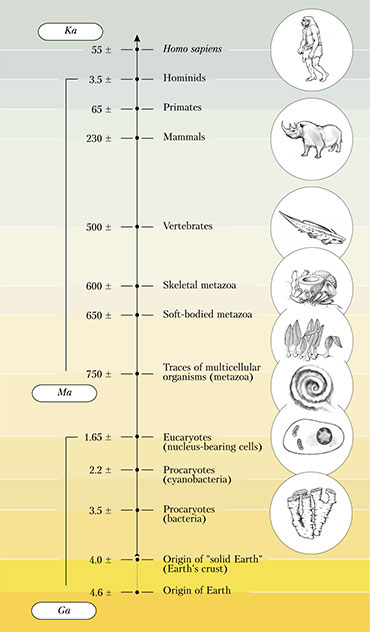
The procaryotes are often believed to have originated 3.5 and the eucaryotes about 1.65 byr ago, but some data indicate that they may have appeared simultaneously. Moreover, cyanobacteria might have already existed in the Isuan sediments, i. e., were coeval to land. The point is more so exciting that it is a clue to the onset of evolution: whether there was an evolutionary change of bacterial forms or no evolution yet.
This problem is closely related to another vexed question, the hypothesis of panspermia or the extra-terrestrial origin and transport of life. However, the question «terrestrial or extraterrestrial» would become less disputable if we use «and» instead of «or», i. e., «terrestrial AND extraterrestrial» instead of «terrestrial OR extraterrestrial», complementary instead of alternative. Panspermia may have just opened up new avenues for the evolution in the sense that some organic blocks supplied from outside would come into competition with the Earth dwellers and thus trigger the selection.
If it was so, these are most likely archebacteria that were brought in, which were able to exist in the most incredible conditions, even in nuclear reactors fatal for any life. Then the alien archebacteria might have competed with the procaryotes, and the eucaryotes arrived later and pushed the archebacteria away into very particular niches. Since then these were the eucaryotes that trailed the via regia of the evolution and provided a basis for biomass. Thus started the evolution scale that eventually arrived at the origin of man. Our main concern here is with the ways of life propagation – I mean the very origin of life in its most primitive forms rather than terrestrial or extra-terrestrial origin of consciousness. If it is transported by wind and water why should not it come with meteorites, just as another way of transport?
When the methane was used up
Moving on. Paster’s point about 2 byr ago marks the critical concentration of free oxygen corresponding to the onset of oceans in the modern sense. Before that time liquid existed in hot sodic or highly saline lakes and pools, as is indicated by analysis of the Isuan siliceous rocks which record a 100 °C temperature of the Earth’s surface.
Eukaryotes initiated the world into the “sex problem”There is another point worth mentioning. Everything that concerns the Archean, most ancient Earth’s history, is of great importance in terms of understanding the origin of early life forms. There remains much we shall never learn about but we can get to know Archean lakes, not just through guess or hypotheses but really see face to face. Many scientists think that «black smokers», hot vents on the oceanic bottom, may be considered a model of Archean lakes.
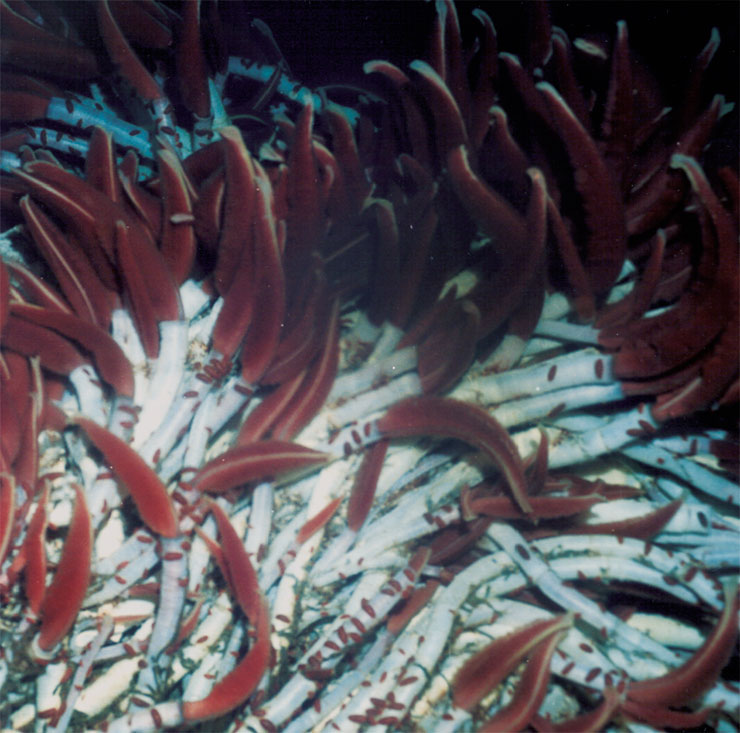
Biomass around the «smokers» is composed of chemo-synthetic organisms, which appears reasonable as photo-synthesis is impossible at a depth of several kilometers. Note that the chemosynthetic biomass production is much higher than modern biological systems! Therefore, photosynthesis is not so crucial for the development of life. It appeared and became dominant after all methane had been used up, as well as all other elements indispensable in chemosynthesis.
Life around the «smokers» rises surprisingly fast. The vents exist for a short time and are separated by as large distances as thousands of kilometers, but chemosynthetic forms emerge immediately around any new «smoker». The «embryos» of such organisms can hardly be transported for such long distances. The nutrition of the deep-sea shrimp Rimicaris exoculata, found by the thousands near the “smokers,” relies primarily on symbiotic bacteria living in their enlarged gill chambers. These chemosynthetic bacteria produce organic compounds that enter the shrimp’s body directly through the integument, bypassing the digestive system.
Division of labour was not an invention of capitalism, the idea belongs to metazoaHowever, I am far from saying that the dense methane atmosphere dominated through the Archean and Proterozoic. A more oxidized setting may have existed in some territories as well, and the trend definitely was towards a decrease in methane plumes with the hydrosphere propagating. Gradual replacement of the methane plumes for millions of years eventually reduced their contribution in biomass production to hundredths and thousandths fractions of a percent, but the ability for chemosynthesis probably persists in the genetic code of living organisms.
Metazoa come into play
Turning back to the biogeochronology. Timing the origin of multicellular organisms (metazoa) is an all-important matter as it was a breakthough in the evolution. Unlike the single-celled in which the whole organism has to care about food, breath, motion, and protection, the multicellular organisms developed specific organs responsible for different functions. The origin of metazoa is most often timed at 750 myr, though some data attest to an age almost twice as old. The truth is difficult to get for they left almost no traces being void of skeleton: soft tissues rarely leave imprints on sediments. Later species of metazoa, whose imprints are occasionally found in rocks deposited about 650 myr ago, apparently possessed a chitinous coat. Of course, it was just some outer denser tissue rather than a carapace in the usual meaning. Anyway we in our scientific trip should be aware that pre-skeleton organic relics had very few chances to preserve. Unfortunately, the geological archive thus misses many opening pages, but this can’t be helped.
THE CHILDRENS ENCYCLOPEDIA 100 YEARS AGOLife could not use much oxygen because only a limited amount was available in the water. The store of oxygen was too small and was spent economically only for urgent needs. That amount of oxygen was far insufficient to develop excess heat.
If we bring all the existing animals together and examine them carefully, we shall see only two large groups, in spite of a visible diversity: animals with and without vertebral column. The invertebrates can hardly be subdivided
into units. They have no encephalon, though it does not mean they are unable to feel. On the contrary, many invertebrates, such as bees, have highly developed senses.
However, all the existing species of vertebrates, starting with fishes, are very easy to classify. Moreover, it is possible to detect which class appeared first and which was the last to appear. Many scientists tried to classify invertebrates in the same way, too, but failed
The organisms endowed with skeletons are quite a different matter. The earliest skeletons are very preliminarily timed at 600 myr. Evolution tried various kinds of skeletons, such as a single calcareous spine in soft tissues, a dense chitinous cover, a shell, etc. Eventually shells were selected as a universal skeleton, most likely in the latest Vendian-earliest Cambrian when a high concentration of calcium in the sea water allowed the formation of carbonate skeletons. On the other hand, skeletons turned to be useful in the expansion into new niches. Later on the functions and the forms of skeletons became more diverse, including inner skeletons.
Salutary ozone
In the Ordovician (about 450–480 myr ago), the development of the ozone layer resisting hard ultraviolet radiation was a turning point in the evolution. Before that the photosynthetic life was confined to a depth range of 20 to 50 m below the water surface to save from ultraviolet radiation above and the light deficit below.
Thus, since Ordovician time the evolution has taken its Darwinian course which was impossible before when many niches remained free. The true evolution, with competition and selection, started after the ozone layer had formed and the living organisms spread everywhere from deep oceans to high mountains. Therefore, it is no exaggeration to consider the Ordovician as the onset of the modern biosphere. The pre-Ordovician bio-mass, though more voluminous, was only bacterial, i. e., qualitatively different from that of nowadays. Note that studies of 1.2–1.4 byr old oil-bearing deposits cast doubt on Vernadsky’s law implying almost invariable biomass through the known Earth’s history. Apparently it did change, and the changes may have reached orders of magnitude.
Climatic swing
A few more words about another major agent that has controlled the evolution. I mean a global climate change. Glaciations began on the Earth about 2.2 byr ago, at least no reliable signature of such cold times has been found in earlier rocks (the hypothetical glacial in the latest Archean is disputable). Earliest glaciations were weak and random, ice was restricted to high latitudes and never extended into the subtropical regions. More frequent glacial cycles are recorded since 750 myr ago when the Earth experienced a global-scale catastrophic glaciation. The Earth froze up, all covered with ice, and resembled a snow ball. That abrupt break in the environmental balance may have killed everything living, and the recovery of life required a long time.
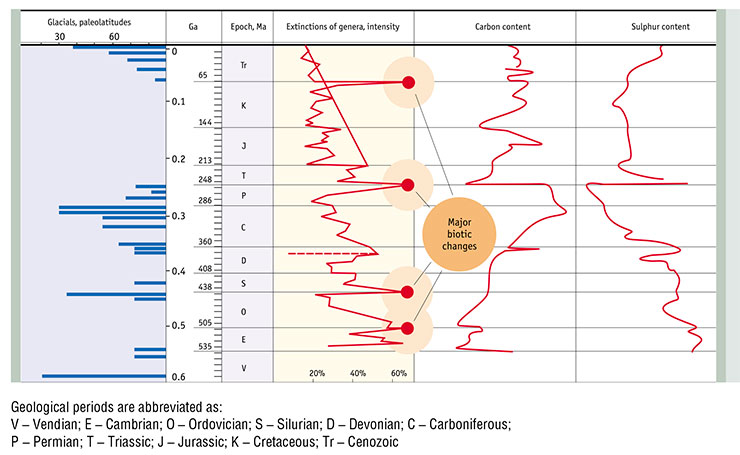
Glacials alternated with warm stages. The Earth has been swinging between two points of stability through the past 750 myr: either ice sheets covered over a half of its surface or it was almost free from ice. Mesozoic time (250–65 myr ago) was the warmest with the mean air temperature 20–25 °C higher than now. The tropic regions looked like the modern ones but palm trees grew in the Arctic and Antarctic zones as well.
Glaciations are caused by various factors of extraterrestrial (insolation and orbital forcing) and terrestrial (e. g., volcanism) origin.
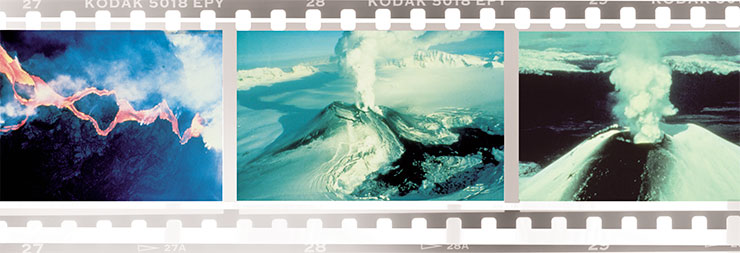
Even nowadays the amount of carbon dioxide produced by volcanoes is an order of magnitude in excess of that emitted by all heat power plants worldwide! Therefore, the cultural effect on climate so much discussed recently is greatly overestimated. Natural factors are purposely underestimated and human activity is overestimated, in somebody’s interests. For instance, the acid rains on European Russia claimed to result from unwise economic activity are actually a consequence of catastrophic volcanic eruptions (of the kind of those in the Philippines) whereby a great amount of ejected solid sulfur is transported through the stratosphere and turns into acid showers which cause degradation to many ecosystems.
A number of studies provide solid proof that acid rains were responsible for large-scale extinctions at the Cretaceous/Paleogene boundary, without any industry.
The boundaries between cold and warm stages are marked by the most dramatic changes in biological species, genera, or families. The speciation curve (based on various data, including extinctions) matches well the alternation of cold and warm cycles in the Earth’s climate history: Extinctions were especially notable in the Late Ordovician, at the Permian/Triassic boundary, and at the Cretaceous/Paleogene boundary. Moreover, this curve obviously correlates with the carbon content curve and is in antiphase with the sulfur content (dynamics of volcanism). Thus we deal there with global environment events rather than local extinctions in local niches.
Mountains are growing!
Besides a global change, another driving force of evolution is the frequency of climate pulses. The greater their frequency and amplitude, the faster the speciation can be.
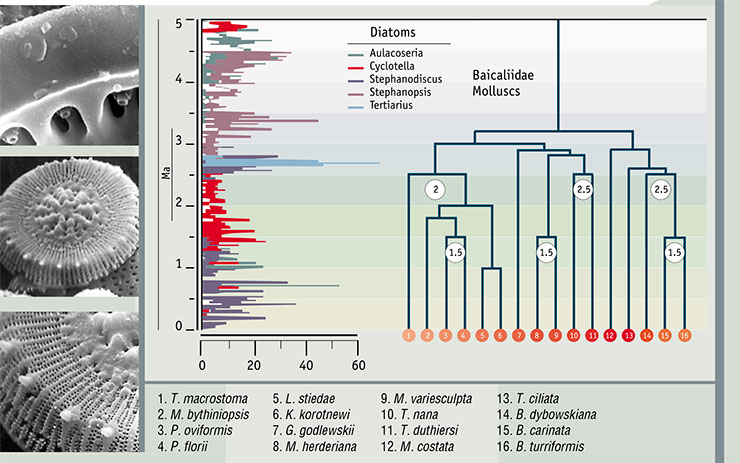
Mountains also have a gift for painting: The Himalayas gave quite a new colouring to the Earth’s climate pictureFor instance, the limnic system of Lake Baikal has remained almost invariable through the past 25 myr, which made scientists think that its endemics (75 % of species in the lake are endemic) are likewise as old as 25 myr. Not likely! A special analysis using molecular biology techniques showed rather 3 myr, the time of an abrupt cooling. The following speciation pulse occurred 700–500 myr ago and was associated with swinging cold-warm contrasts, though the average climate parameters were stable.
The role of climate in the evolution can be discussed for ages dwelling upon various particular things, each being, however, essential.
Say, mountains cause a strong influence on climate, not only because they grow and then degrade thus changing the atmospheric circulation. Note that the mountains remained no higher than 4000 m almost all the Earth’s history through, and the peaks up to 8000 m have risen only during the past 3 myr. This sudden growth turned over the atmospheric circulation (the Himalayas worked especially hard) and, hence, the climate setting. Prior to the mountain growth, the system was more or less balanced, at least it tended to equilibrium, i. e., to temperature adjustment among different regions, whereas the newly risen mountain ridges induced climate «turbulence» such as the Arctic whirlwind, Mongolian anticyclone, or Pacific typhoons…
Another example, again with Baikal. It was found out that cold times were accompanied by extremely strong winds and dust storms. (The dust storms made for deposition of loess, friable sediments composed of silt particles.) Thus extinction of many species was caused by dust more than by cooling itself. Land plants and subsurface water-dwelling organisms, such as diatoms, are very sensitive to dust. Diatoms normally reproduce in March and April when ice starts to melt. But there’s no question of reproduction when dust is covering the ice, the organisms just die…
You may see that the story has approached our times and definitely has moved to our home lands. To put it differently, the synopsis of the evolution is coming to its end. We got a quite chequered snapshot with many territories explored and no less numerous blind spots.
Hopefully, our joint efforts will allow an insight into most of these blind spots.
: 31 Oct 2026 , Academician Dobretsov: On the Crest of the Plume , volume 72,
N2